

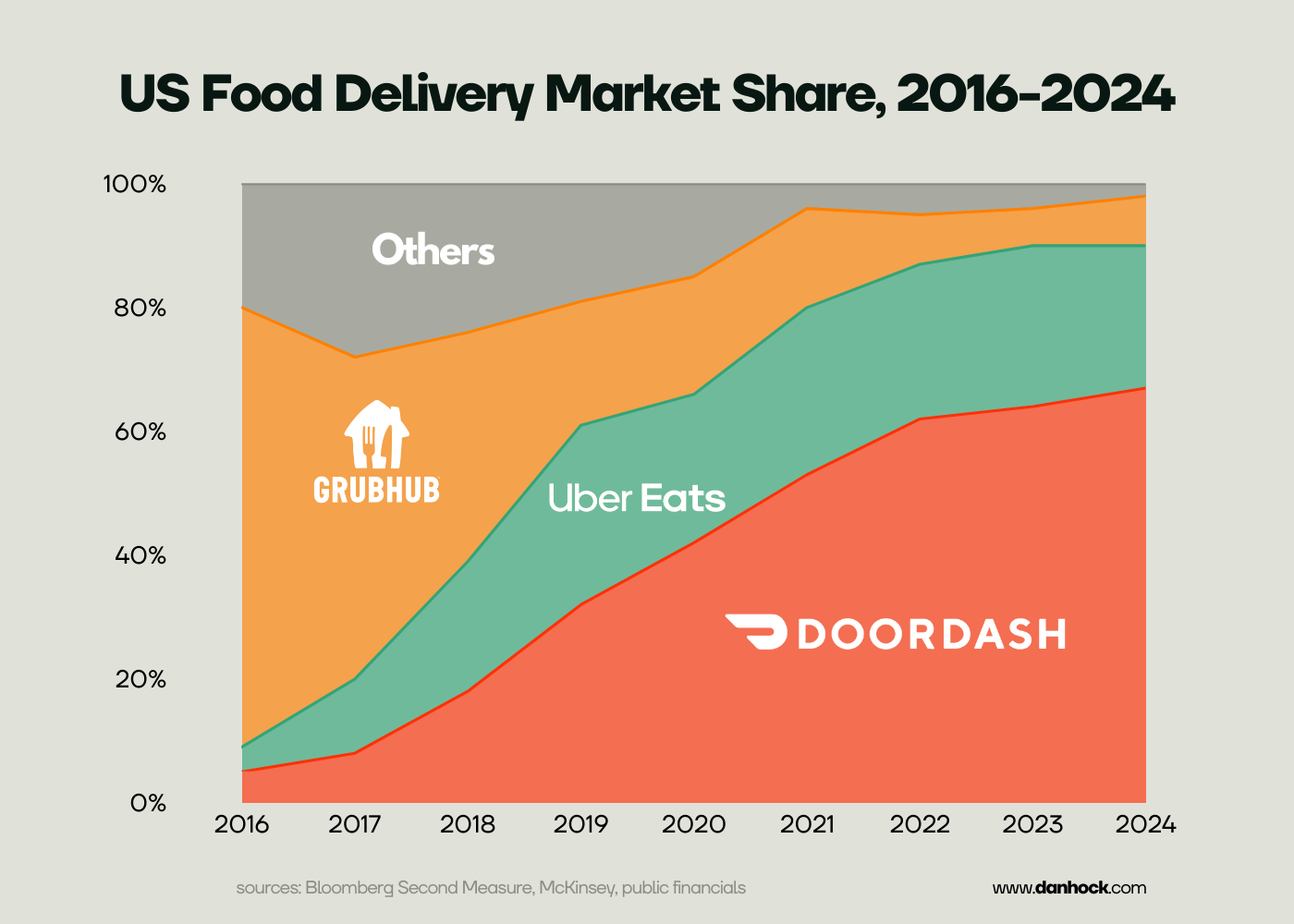
The business school version of why DoorDash won is that they had the right strategy. They launched in the right markets, acquired the right restaurants, and designed the marketplace the right way.
The Silicon Valley hustle culture version is that they out-executed everyone else. They just shipped faster until they had better selection, a better product, and more reliable delivery.
The financial markets version is that they got lucky. Grubhub and Uber were both public and playing with a hand tied behind their back during the most pivotal moment in the fight.
The reality is that you can’t understand what happened without all three perspectives. Increasingly, success in every competitive market will require the right strategy, rapid execution, and good luck.
Strategy
Strategy turns on a few big decisions. For DoorDash, three of them really mattered.
The first was recognizing that owning delivery was the key to unlocking supply. Most restaurants can’t support the economics of running their own delivery fleet, so the Grubhub model of just routing orders to restaurants was bound to hit a wall.
DoorDash was the only company that launched with the business model that everyone now uses. The initial idea for Uber Eats was to load cars with fresh meals made at scale so they could be delivered as fast as possible. Postmates started with packages, not food.
DoorDash recognized the importance of logistics from the start. This was CEO Tony Xu’s final slide at YC demo day in 2013:

The second big decision was seemingly at odds with the first. Rule #1 of building a logistics business is to increase network density and thus driver utilization. This led everyone else to major city centers.
But DoorDash realized the suburbs were a better place to start. There, the alternatives to delivery were much worse, customers were more affluent, and average order values were higher. Customers immediately understood the value prop and spent enough to make delivery economics work.
Most importantly, no one else was in the suburbs yet. This is a key principle in Sarah Tavel’s Hierarchy of Marketplaces:

To win in a market, you can’t just be the market leader. You have to be the market leader by a lot. This creates a flywheel in which you have much more demand, which allows you to bring on more supply, which in turn compounds your demand advantage. Every market in food delivery was ultimately hard fought, but DoorDash’s initial wedge in the suburbs gave them an advantage no one else had.
Finally, DoorDash recognized that the most important thing was a wide selection of restaurants, even if that meant sacrificing other things that customers cared about, like delivery speed and price.
They realized that as long as they could deliver in about 40 minutes, there were limited gains from being faster. Uber tried to optimize for faster delivery, which led to the wrong decisions, including launching with the wrong business model in the first place.
DoorDash was also willing to initially make the service more expensive for consumers, which allowed them to give commission breaks to important restaurants to convince them to join. Uber instead wanted a flat customer fee, which required them to play hardball with restaurants. Later, DoorDash did begin to win on price (in particular through DashPass and lower markups on food items), but only once they had great selection.
Execution
DoorDash had the right strategy, and still almost failed.