

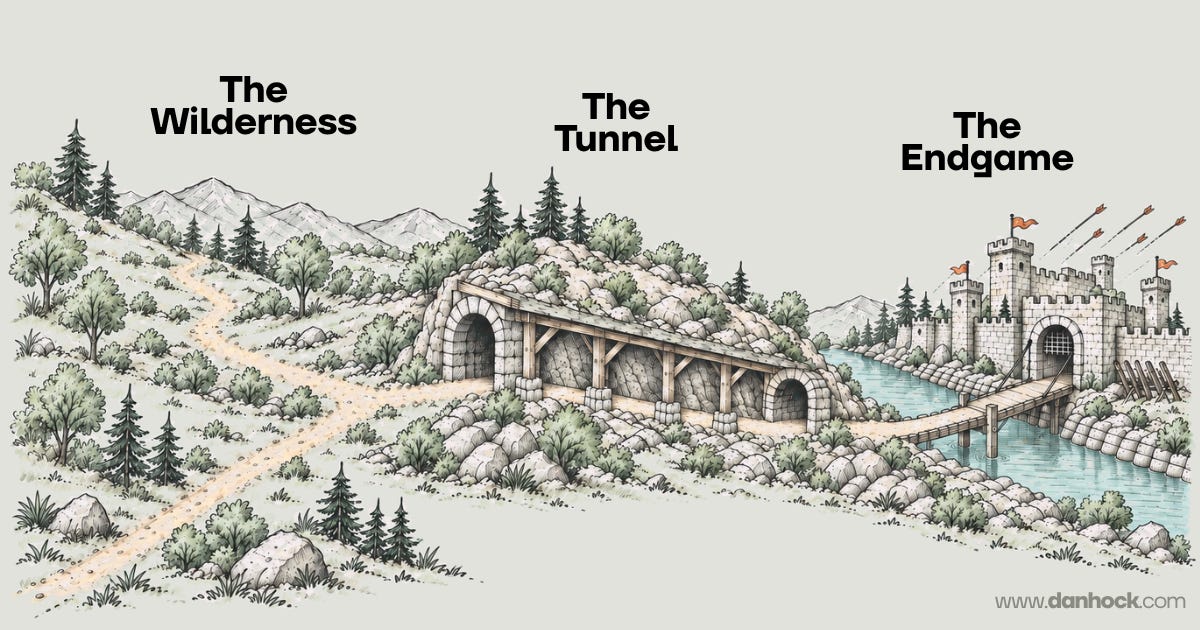
A startup begins in the Wilderness. There is a founding team, a vision, and maybe an early product. Degrees of freedom on where and how to compete are high. It’s still possible to make major changes or pivot entirely.
But then it starts to get traction, and enters The Tunnel. It raises a bunch of money, growth expectations go up, the team scales. Decisions about which segment of the market to pursue, how to design the product, and how to grow start to come fast and bring real trade-offs.
The tunnel exits into The Endgame. Now it’s clear what the playing field is, who the players are, and on what terms they must compete. It’s hard to change course even if the conditions are unfavorable, because it would break the expectations of an army of investors, employees, and customers.
It’s hard to tell who has a moat until the endgame. Many startups accelerate into this phase only to stall out, finding it hard to keep growing or increase monetization. That’s the story being told by every Bending Spoons acquisition, including Eventbrite, Airtable, and Miro.
The risk of this outcome is ratcheting up, because rapid AI adoption is making everyone’s early numbers look good, attracting huge rounds and extreme competition in the process. When the tide goes out, who among Lovable, Suno, ElevenLabs, Harvey, Gamma, and the labs themselves is going to be swimming without a moat?
Because the pace of change is so high and the fog of war is so thick, many people are just ignoring the question. They say there are no moats anymore. Or they say execution is the only moat: sprint to build a great product and get distribution, and the rest will sort itself out.
They’re focused on momentum: forward progress that helps a company advance between stages.
But that’s not a moat: something that is actually hard for competition to replicate, even once the deep pockets show up.
Momentum without a moat is a recipe for racing to build a bad business. Here is how to avoid that fate.
Momentum is currency
When people say execution or distribution are moats, they are confusing a means of gaining defensibility with the thing itself. Momentum is best thought of as currency you can spend toward digging a moat.
Distribution provides the raw ingredients that can become defensibility: a user base, deep engagement, the data it generates, the scale of operations it enables. Brian Balfour put it well in The Big Squeeze:
Distribution creates momentum that can lead to all kinds of good things. Distribution isn’t success in itself, but an opportunity to capture it. It’s the very first step in building a moat. The question is if you can sequence the distribution to a real moat.
Execution velocity increases the shots on goal a company has at turning those raw ingredients into a moat. Early on, when everything is still up for grabs, speed is the most important thing. As the company and its competition take shape, value shifts to where that speed has taken them. At seed, you’re betting on the team. In public markets, you’re betting on the position.
Paths to Defensibility
So the question is: what can you convert momentum into?
Hamilton Helmer’s 7 Powers is still the best taxonomy of moats. But AI is re-rating their relative importance, as well as making an 8th (data effects) much more important.
These moats emerge at different times in a company’s lifecycle (Helmer’s “power progression” concept), which gives them very different practical value.
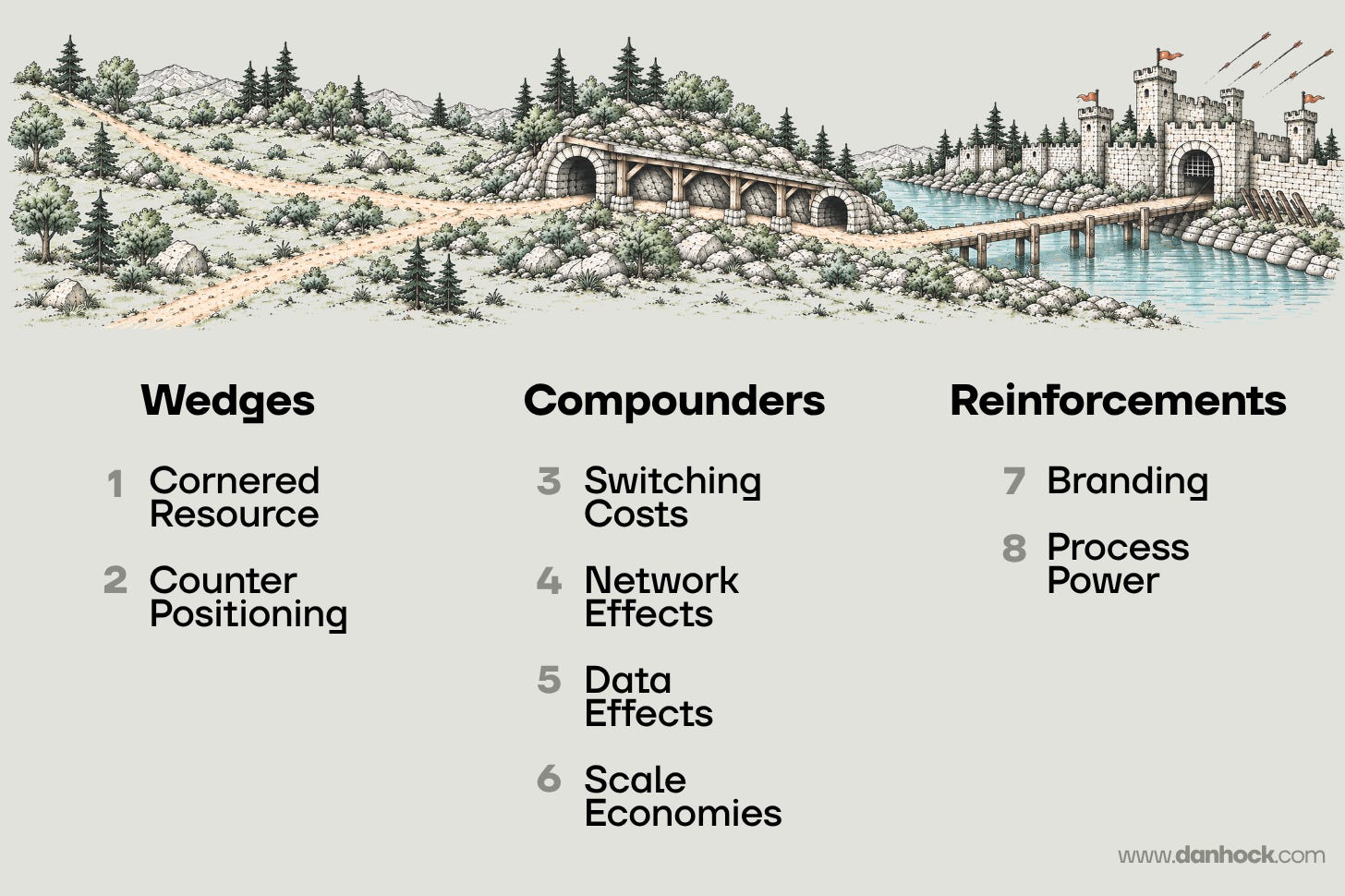
Wedges provide an early advantage and help buy time to build something more durable, but are rarely enough on their own.
Compounders take shape during the tunnel and can continue to strengthen as the company matures. The vast majority of all value is derived here.
Reinforcements can fortify defensibility, but take too long to matter for most tech companies.
As we unpack each, we have to distinguish between what Helmer called a “benefit” (an economic advantage) vs. a “barrier” (when that advantage becomes hard for even well-funded competitors to copy). A benefit fuels momentum, but only a barrier is a true moat that persists into the endgame.

1. Cornered Resource
A cornered resource is preferential access to a valuable asset. That could be a patent, physical resources, regulatory favor, or most commonly, the founding team itself.
A strong founding team (perhaps a repeat founder who knows the industry well) can fuel momentum by making it easier to raise money or by making fewer mistakes.
In outlier cases, this can be exceptionally valuable. Jeff Dean recently announced he was leaving Google along with three of his collaborators to found Discovery Loop, an AI company aimed at speeding up scientific discovery.
The new company has no product, no customers, and no office, and they’re raising a billion dollars at a $10B valuation. You could say that $10B is the price investors are putting on the cornered resource of the founding team. It is easy to see why: they are collectively a meaningful percentage of the top-cited AI and distributed systems researchers in the world.
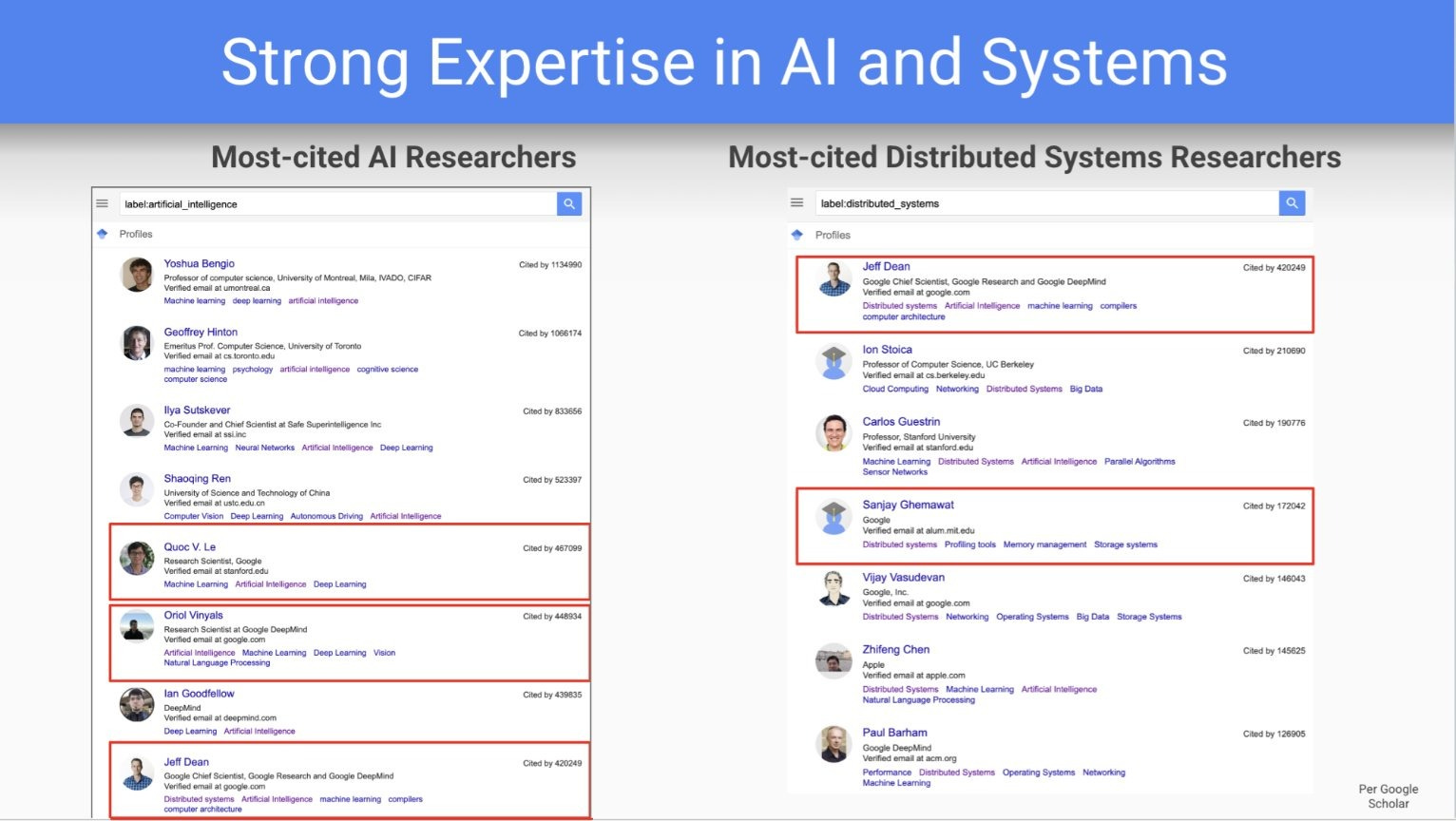
But as has become clear as we’ve seen talent switch freely between major labs over the last 18 months, even the most extreme cases of cornered resources are typically temporary wedges rather than long-term moats.
2. Counter Positioning
Last month, Tibo at OpenAI tweeted about how Google basically built ChatGPT before ChatGPT, but didn’t launch it:
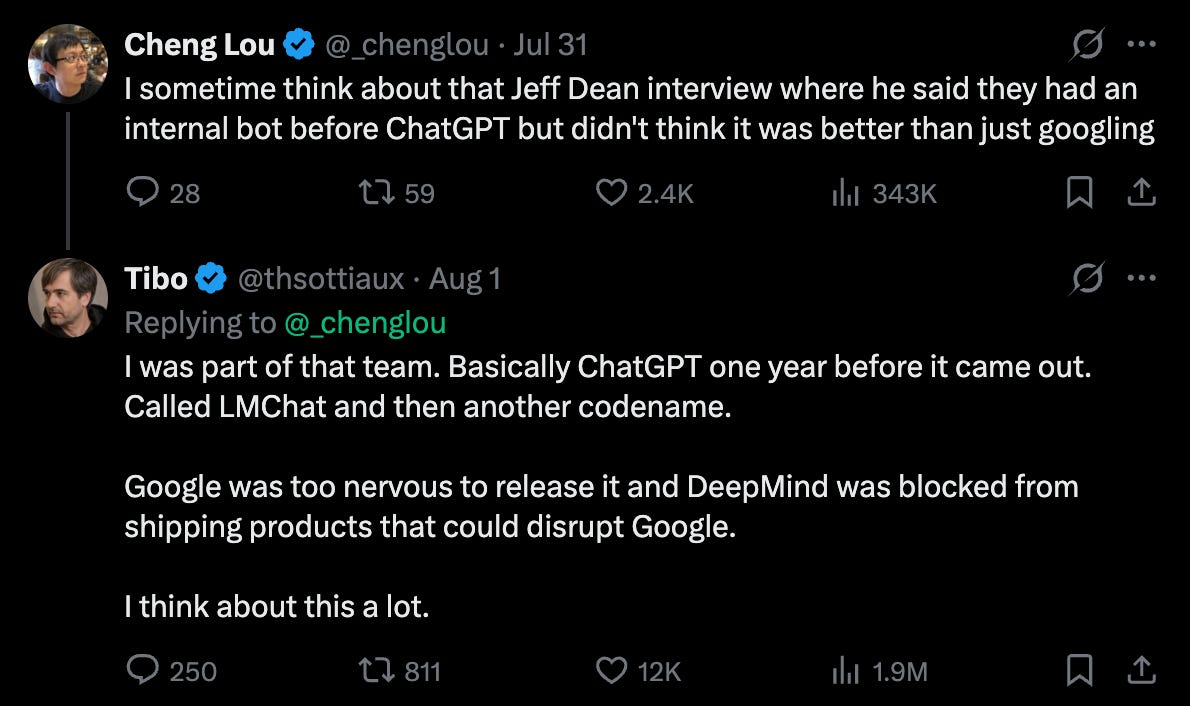
This was not irrational on Google’s part. The probability that a chatbot would work was low enough, and their search business was profitable enough, that launching the internal product had negative expected value. That’s what counter-positioning means: incumbents will not copy a startup, even if they’re fully aware of the potential threat, because it would damage their business.
Cheap intelligence is creating all kinds of new opportunities to counter-position. Chief among them is using a lower marginal cost product to disrupt a business model that today charges a lot for humans. That’s true for OpenEvidence (clinical reference), Sierra (customer service), and Speak (language tutoring).
But at the same time, the expiration date is shortening. The feedback loop has never been faster between a company getting traction and a violent response from founders and VCs to create well-funded direct competition.
Counter-positioning rarely becomes long-term defensibility. But it can provide a valuable air pocket in which to build momentum with less heat.

3. Switching costs
Software historically derived much of its value from switching costs. My favorite example: it wasn’t until 2019 that Amazon migrated fully off of Oracle databases, 13 years (!) after they launched AWS.
True switching costs don’t just mean a product is sticky. A moat emerges when switching costs become so high that customers actually expect to lose more by switching than they have to gain.
So it’s both about how hard it is to switch and how much better the new thing is. AI is weakening the power of switching costs both by creating much more valuable new products and by eliminating a lot of the annoying and costly parts of migration.
But it’s not true, as many people seem to think, that switching costs no longer matter at all. Switching costs come from three things:
Hard costs: the actual time and dollars it takes to migrate
Workflow tax: the whole team has invested in learning a certain UI and would have to re-learn a new one
Risk: companies are additionally unwilling to touch anything that manages a business-critical function like payments or infra, or carries legal or regulatory risk
AI is clearly impacting the first, but doing much less to the second two. It’s not hard to see how companies like Abridge (AI-driven clinical documentation) could become difficult and risky to rip out. After watching multiple implementations of products like Decagon and Sierra and all of the internal process that get built around them, I could believe the same about them.
Switching costs have historically been an enterprise phenomenon. Could AI be the first time we start to see them show up for real in consumer? The way that memory and skills have been implemented by the frontier labs is a weak case for switching costs. But a new generation of tools like Grok Bot or Instinct that integrate deeply across tools and devices and handle a bunch of sensitive information could make switching much harder.
4. Network effects
Network effects were the king of moats in the internet era. Some have claimed they drove 70% of all value in tech.
That is not surprising given that the internet was a technology of distribution. It made it easier to connect people at a scale that wasn’t previously possible, leading to massive winner-take-all dynamics. Consider Roblox: 62% of all US kids age 10-12 use it, averaging 143 minutes per day. Good luck starting an alternative.
In contrast, AI is primarily a technology of production. It’s more about building things than connecting people, and as a result, many of the new products are single-player.
Some have responded by saying founders should just build more multiplayer products, but of course it doesn’t work like that. A network effect has to be directly aligned to the way the product creates value and the way customers want to use it. It’s not something you can bolt on.
So, particularly in consumer, it seems possible that network effects may just be less important now. TikTok already started undermining the network effect of social products by replacing the social graph with the algorithm. AI could complete the swing by removing the need for human creators altogether.
But there will certainly be interesting network effect businesses built, including some on the enterprise side. HuggingFace and OpenRouter are both good examples. The strength of their network effect will depend in part on whether we see an oligopoly in OpenAI and Anthropic, or whether we see more significant fragmentation among frontier labs and open weight alternatives. In the latter scenario, they could build quite a strong network effect.
5. Data effects
If network effects were the king of the internet era, data effects might be the king of the AI era.
Helmer treated data effects as a weaker subtype of network effects. His premise was that they exist, but tend to asymptote too fast because it wasn’t that hard to get a sufficient level of data to compete. That was true when he wrote it, but I don’t think it’s true now. The nature of AI allows for a much longer asymptote. It’s the difference between Amazon’s search algorithm getting “good enough” vs. Claude hitting new step-changes in productivity with each training run.
But for data to turn into a real moat, it must have two properties.
First, it must be hard to replicate by competitors. Today, that usually means it must be data your own product generates, because companies like Mercor and Handshake are working hard to make everything else purchasable.
Second, it must directly improve the product, in a way that creates a compounding loop. Many of the most successful AI businesses will have a basic flywheel at their core:
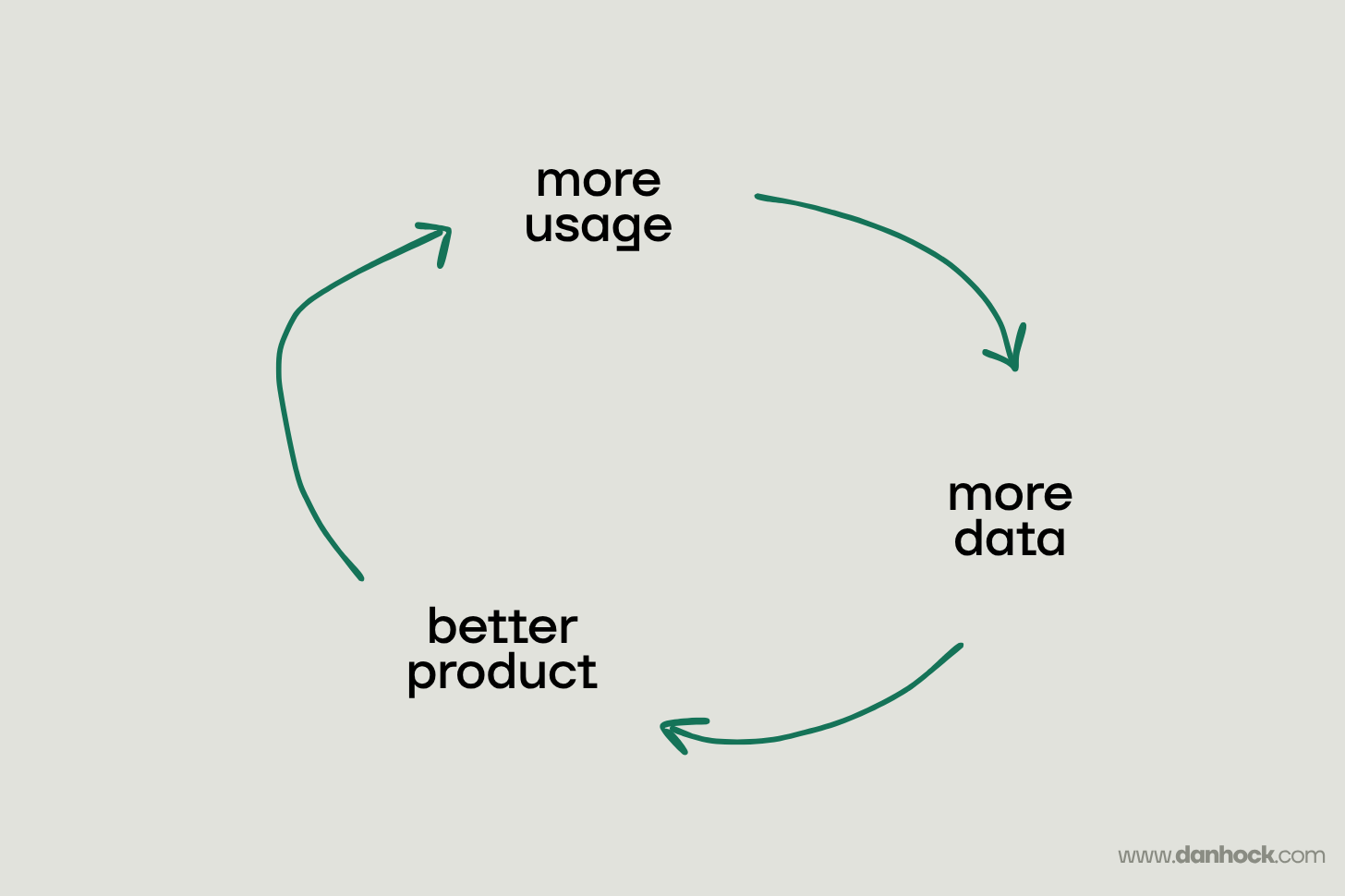
Cursor was the canonical example of a data loop, with the model getting better with every user accept or reject. That did create an amazing product and carve out a meaningful market position. But they also had the good/bad fortune of picking the single most lucrative market in AI, meaning the deepest of all pockets would show up to compete.
In contrast, vertical AI companies like Legora or EvenUp may get a longer window to turn their data flywheel before model providers turn their sights on them, creating the ability to dig a moat that is hard to catch up to.
6. Scale economies
Scale is the OG of moats, with us in force since the industrial revolution.
It’s not enough to simply have low marginal costs and amortize fixed costs as you grow; most software has that. Scale becomes a defensible moat when unit costs decline as production volume increases, allowing a company to charge less or earn more for the same product. You have to reach a different point on the cost curve altogether.
For AI, it seems the question of “are scale economies viable?” gets murkier the farther you get from infrastructure.
Clearly, many of the businesses providing infrastructure to power the AI revolution (Nvidia, TSMC, AWS) have massive scale economies.
It’s harder to tell whether the frontier models have them. There are clearly scale mechanisms in both training and inference, but OpenAI, Anthropic, and small number of others may still end up locked in competition at similar places on the scale curve. Benedict Evans is worth reading on this topic.
It’s even harder to tell for application companies. There are many that claim lower cost-per-outcome (e.g. Intercom training its own model for Fin, which can resolve CX issues at lower cost). But the real question is how expensive it would be for someone else to do the same thing. It is worth exploring this path in spaces where there appears to be a deep cost curve from scale. However, the test must always be: “will this persist even when someone raises a billion dollars to try the same thing?”

7. Brand
Brand is perhaps the most over-rated moat in tech. To see why, it’s useful to look at a real one.
In 1982, seven people died in Chicago after taking Tylenol that had been poisoned with cyanide. Market share briefly dropped to zero as Johnson & Johnson pulled all 31 million bottles from shelves. But within a year, market share was back above 30%, where it has remained to this day. Tylenol still sells for 5x the price of chemically identical generics.
That’s when brand is a true moat: customers value it so much that they are willing to pay more for the same product.
This takes decades to build and requires an industry so established that the product is a commodity. Neither startups nor the industries they operate in are old enough for that to be possible.
Many point to Airbnb or Stripe or Figma as strong brands. They have great design, great messaging, and people love their products. It’s true there is a real benefit there: on the margin, customers are more likely to choose or stick with them over competitors.
But if their product killed seven people and was 5x more expensive than alternatives, we all know what would happen. Heck, Stripe and Adyen compete over basis points.
And those are the best examples. Is it likely that an AI startup founded 24 months ago has a brand that would actually be hard for truly deep-pocketed competition to overcome?
For startups today, it’s worth considering leaning into brand as an accelerant, treating brand spend as a delayed form of CAC. But it can’t be counted on as a moat.
8. Process power
One way to think about process power: it’s the narrow case where execution can graduate from momentum into a moat. It’s a deeply embedded, uncopyable way of working developed over many years.
You can argue Palantir has this. For 20 years, its forward-deployed engineers have embedded in messy customer environments, solved problems alongside them, and fed what they learned back into not just the product but the machinery of the org: how teams deploy, how they work with customers, what gets generalized, how people are hired and trained. They call it the “human equivalent of backpropagation.”
There is a new generation of startups using the FDE model to act as the implementation layer for AI. Can they develop process power? I’d bet that some will, as they get to the edge of what it takes to turn intelligence into productivity and plow that back into their product and operating model. That’s worth pursuing, but it will also take a long time, and in the meantime they should be looking to other forms of defensibility.
Momentum starts the clock
There is a central tension in all of this:
Early on, the founder’s #1 job is to build momentum. It’s never been harder to break away from the pack, and you don’t have a chance unless you do.
But when momentum comes, the pace of growth and the competitive response are faster than ever. It starts the clock on digging a moat before someone else does.
The way to break this tension is to have a theory of defensibility from the start. Focus primarily on pace of execution, building a great product, and getting many people to use it. But have an idea of at least one path to defensibility, and how today’s decisions bring the business farther from or closer to that path.
The good news is that there are still many viable moats. They’re getting re-rated by AI, but the fundamentals are the same. Teams that consider this from the start have a better chance of going the distance.
Thank you to Brian and Zach for reading a draft of this essay.