

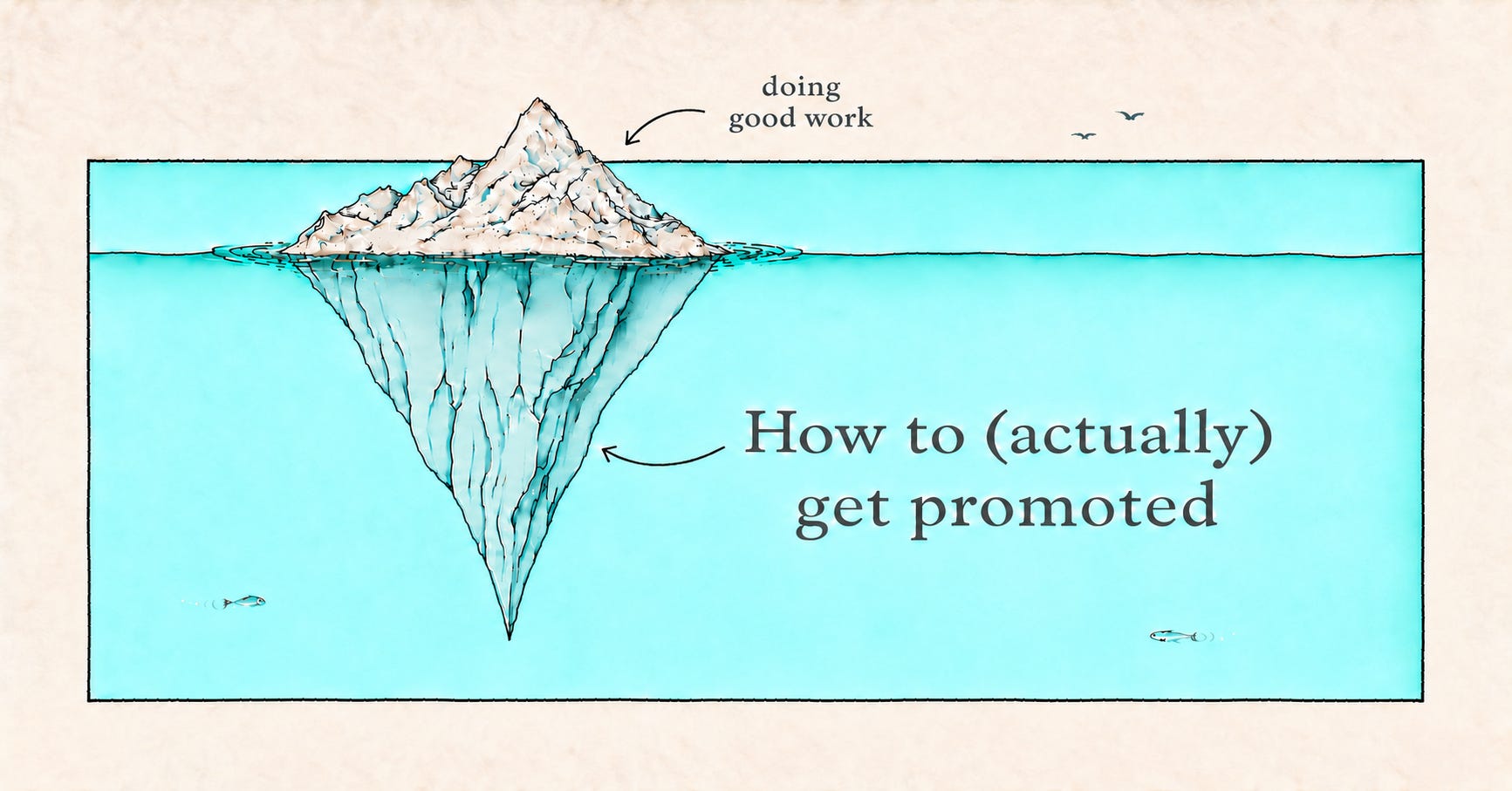
There’s a lot of advice written about how to get promoted. It is usually some combination of:
Do good work in your current role
Figure out what the “next” role is, and start doing it before you’re promoted
Ask your manager what else would be helpful, and do it
This is good advice. But we all know someone who consistently follows it and still repeatedly gets passed up for promotions. Maybe you’ve even been in this position yourself.
That’s because doing good work is necessary, but not sufficient. It misses a large part of how promotion decisions actually get made inside companies. Yes, you must perform well and demonstrate readiness for the next job. But then leadership must sit down and actually decide to give you the promotion, instead of giving it to someone else and instead of just waiting a year.
I’ve been in that room for hundreds of promotion decisions, and the quality of the work is not the only thing discussed. It’s often not even the primary thing discussed.
All the other factors get talked about much less. Perhaps they seem too abstract. Perhaps they feel too cynical.
Whatever the reason, unless you have a mentor who will tell it to you straight, you’re probably not getting the whole story. That is what I want to try to fix with this essay.
The core of the advice: assuming you’re already doing good work, you are much more likely to get promoted if you can achieve four things:
Legibility
Likability
Location
Leverage
I’ll define what each of these means, and give concrete examples of things you can do to develop them.
1. Legibility
How do promotion decisions actually get made?
For most promotions, and certainly anything at Director or Staff level and above, there will be a conversation (often called “calibration”) that extends beyond your team or department. It will include leaders from other departments, and often the CEO or other executives.
This happens because budget and optics are real constraints. Lots of people want these seats, and only so many people can have them. For each promotion decision, disciplined companies ask themselves: “If we give this person a promotion, who are the next three people that are going to think they deserve one as well?”
When your name comes up in the conversation, you want multiple people around the table to say, “Oh, obviously they should be promoted.”
For that to happen, your work must be legible. That means execs or leaders beyond your manager know that you did good work, what it was, and how it impacted the company.
How can you make your work more legible? Some people go on a marketing offensive, writing a glowing self-review or pitching their accomplishments to leaders. This rarely works, because it comes off as self-promotional. Here are some things that do actually work:
Put visible wins on the board. There is no better way to increase your legibility than to become known as “the person who figured out X”. What “X” is will be highly dependent on your role, but you probably already have a few ideas of what it could be. That new growth channel the team is trying to launch. That strange trend in the data no one can figure out. That big partnership or customer everyone wants to land. So ask to work on it, or just go do it. And when it works, don’t be afraid to talk about it. Share it with relevant people. Write up a doc on how you did it. Present it in your team meeting or all-hands. Getting in the habit of putting up visible wins is rocket fuel for your career.
Become the most AI-pilled person in your department. There is a brief window, which started 18 months ago and will probably last another 18 months, where there is extreme upside in becoming AI-pilled. Every leadership team cares about implementing AI, and none of them actually know how to do it at the ground level. Learn the tools deeply, figure out how to apply them to your work, start a Slack channel about it, host office hours, help anyone who asks to learn how to use it.
Take high-exposure roles. Some roles are naturally more visible than others. For example, this is the main reason that Chief of Staff jobs are so popular. The actual work usually kind of sucks. It’s mostly glorified administrative work. But you’re also working alongside the CEO or other senior leader, and if you do a good job, it will be obvious to them. The point of these roles isn’t the role itself, but the opportunities they can open up afterward.
Find a champion. The most important bit of all is to find at least one senior person who has your back. This can’t be your manager; it has to be someone like a department head or exec. Someone you can trust, who trusts you, and who will vouch for you at the promotion table. The best way to create a champion is to find someone who has problems you can help solve, slack them about it, and then just go do it. Repeat this a couple of times, and you’ll be amazed by what it yields.
2. Likability
No matter what anyone says, people who are more fun to work with get promoted faster.
Some people interpret this as irrationality: people just want to work with people they like, and ignore the substance of the work.
I don’t think that is what is actually happening. I think that likeability is substance. In the final analysis, it materially impacts the performance of the business.
Being likable does not mean being “nice”. It means being able to maintain optimism, connect with people authentically, and make them more excited about the work you’re doing together.
In short, it means being an energy creator. Building any business (and especially a startup) is an exercise in constantly applying energy. You get kicked in the face ten times a day and have to keep going. It is very valuable to have people on the team who multiply energy instead of sapping it.
Put yourself in the shoes of someone running a department, like a CMO or head of product. One of their core goals, perhaps the thing they care about more than anything else, is keeping the team happy and motivated. A huge part of this is simply how much fun it is to work on the team. But as the leader, they can’t just “make it more fun”. They’re the boss, and it will come off as lame. So when they find someone on the team who makes it fun organically — the person who organizes team lunch, makes people laugh, lights up the team Slack — it’s like striking gold. They’re going to protect that person at all costs.
Likability only gets more important from there. As someone gets more senior, they will increasingly spend less time heads down doing “the work” and more time working with people. The most successful people are those who can recruit a great team, retain them, and rally them around new ideas.
Likability seems like it’s hard to work on. A lot of temperament and working style is hard-wired. But I’m not sure that is so true, because I’ve watched many people get feedback on it and make huge strides. Here are some things that seem to work:
Make sure you legitimately enjoy your job. The first step is just to be in the right seat. If your job feels like drudgery, if you think the work you are doing is not important or you don’t agree with the mission, you just won’t be able to fake it for very long. People can always tell.
Don’t try to sound so smart. As people become more senior, they often seem to think they need to become the “adult” voice in the room. They become more critical of ideas, pointing out reasons they won’t work. There is a place for judgment and discipline, but you will be much better served by a default mode that is generative, creative, and looks for the best in people and ideas.
Show a little interest in your colleagues as humans. You spend way too much time with these people for them to be strangers. Spending a little time learning about them outside of work — their family and friends, what matters to them, what they’re excited and worried about — goes a tremendous distance in building trust. One practice here that I love: before regular team or working group meetings, let everyone go around the room and give a 1-10 score on how they’re feeling, and why. It’s amazing how much closer it will bring you.
Spend time on the “other work”. There is a set of things that are in your explicit job description. And then there is a whole other set of things that aren’t: going to the happy hour, showing up with energy at the offsite, posting something funny in the team Slack. You don’t have to do this stuff, but it does matter.
Figure out how to get real feedback. No one is going to give you unsolicited feedback that you aren’t fun to work with. There is just no upside to it. Instead, they’ll ignore it on your 360 review and just talk about the work. You have to go to your manager or others you trust to intentionally seek out feedback on how you’re actually perceived.
3. Location
As you get more senior, promotions depend more and more on the organization’s need for the new role, not just how capable you are. You could do great work, make it legible to the org, and be amazing to work with. If there isn’t a promotion to give, you’re still not going to get one.
Positioning yourself in the right place in the org is the only way to fix this.