AI transformed software engineering faster than any other field because it is a particularly good fit for LLMs. The context lives in one place, there’s a massive amount of public code to train on, and the output is verifiable.
Data science and analytics are not quite as good of a fit. Context is more dispersed, less of the work is publicly available, and outputs are harder to verify. This means that the transformation will be messier and less complete.
However, anyone applying AI to data science work inside top companies can clearly see that it is going to change a lot, and quite quickly.
What does this mean for data scientists today?
The bad news: most of them won’t be able to keep doing the same job and expect good career options for years to come.
The good news: the need for data scientists isn’t going away, and it may grow in importance. There will be many great career paths for people with these skills.
Jess Lachs is the Chief Analytics Officer at DoorDash, where she leads a global team of 500 across Data Science, BizOps, and Analytics Engineering. (She also has an excellent Substack about data science and analytics that you should subscribe to.)
We teamed up to share where we think things are headed based on what we’re seeing today, what great data roles could look like in the future, and what anyone can do now to prepare.
The evolution of the data science function
Data science started as something like a “research” function. A business partner would bring a question, the data scientist would go away, work through the analysis, and come back with an answer. This often took weeks or longer.
Over the last decade, this sped up. It became much easier to query data, build a visualization, and get a first cut of an analysis. Expectations have shifted from precision to speed. Business teams want answers sooner, even if the first answer is directional.
AI is accelerating this trend for two reasons. First, data scientists can work much faster because AI automates many of the more basic parts of the job, like writing queries, monitoring experiments, and running recurring funnel analysis. And second, anyone across the org can now do their own first pass at analysis.
Today we’re in the messy part of the transition. The boundaries between analytics, product, engineering, data engineering, and operations are blurring. It’s easier than ever to get a quick answer that looks reasonable but uses the wrong metric, misses an important business interaction, or answers the wrong question.
If this isn’t well managed, it will lead to a crisis of trust. Data scientists will stop doing useful work and instead spend all their time checking everyone else’s work. Is this the right definition? Did the analysis account for this other effect? They’ll become a kind of quality control function.
The best companies will dig out quickly, and most others will follow over the next 3-5 years. At the core of this will be analytics “harnesses” that are built on top of a company’s data.
You can think of these as similar to coding harnesses like Codex or Claude Code, but built specifically for analytics. They will manage context, including data structure, metric definitions, how different parts of the business interact, and which assumptions matter. They will know when and how to use 3rd party tools. Most importantly, they will have built-in feedback loops that constantly check the quality and accuracy of analysis.
Ultimately, these harnesses will both supercharge data scientists and, for more straightforward questions, allow anyone at the company to ask a reasonably well-formed question and get an answer they can rely on.
This is the world data scientists should be planning for. For the remainder of this post, we want to answer three questions to help you navigate this transition:
Which data science tasks will matter more, and which will matter less?
What are the viable data science roles in the future?
What can you do now to prepare?
Which data science tasks will matter more and less?
Historically, a meaningful part of the job was doing the analysis itself: writing the query, choosing the cuts, building the chart, checking the data, and assembling the answer. All of that goes away. What’s left is knowing which questions to ask, judging whether the answer could actually drive impact, and landing that impact across the company.
The mechanical parts of the job are getting cheaper, and many are being fully automated. Judgment used to live in query-writing, chart-building, and data-checking, and it’s becoming more important because that’s where AI struggles. And a new kind of work is emerging alongside both: testing the AI’s analysis and catching its mistakes before they become someone’s decision.
Here are a few examples of how things are evolving, task by task.
Example: translating a business question
A business partner used to ask, “Why is this market getting worse?” and you’d spend real time deciphering what they meant and generating hypotheses about the decline before ever writing a line of SQL. Once the question was clear, pulling the data and building the chart was the easy part.
AI is accelerating the mechanical side: pulling the data and building the chart or dashboard now takes minutes. But AI won’t push back if the question itself is unclear. It’ll cheerfully answer a precise version of the wrong question. The judgment is in deciding what the actual question is, and that clarifying work still has to happen, either by the data scientist or built into the tool itself: prompting the stakeholder for what changed, over what period, which metric represents the problem, and what decision this analysis should inform, before any data gets touched.
Example: metrics design
Building a metric tree for a new product used to involve stakeholder feedback and trial and error as the team learned which goals helped and which didn’t. Every new iteration required a new data pipeline and changes to multiple dashboards.
Today, AI can sketch a full metric tree in minutes. The judgment is whether that tree actually reflects how the business works, whether it creates the incentives you want, what trade-offs it’s quietly hiding, and whether anyone could actually act on it. A technically elegant metric tree nobody can use isn’t useful. AI changes the iteration loop: brainstorming potential metrics, building supporting data models, and updating dashboards to test several candidate metrics at once used to be expensive, and now it’s cheap enough to do quickly.
Example: experimentation
Running an experiment used to mean designing the test, configuring the pipeline, validating the setup, monitoring it daily, pulling the readout, and writing up what it meant. Now, much of this can be automated: the t-test, validation checks, monitoring, analysis, and even a first draft of the write-up mostly run themselves.
What is left is judgment: was the test designed correctly? Are there interference effects between variants? Does the result generalize beyond this one market or segment? Is a controlled experiment even the right tool? And what might this analysis have missed? If you can’t run a clean experiment, judgment becomes even more critical as you choose between quasi-experimental methods and decide how much confidence you have in the results.
Even when AI gets the analysis technically correct, judgment is still required to know whether it looked at the business holistically enough. Take a marketplace: a change on one side almost always affects another, and a technically correct answer that only accounts for one side can still lead to the wrong decision. AI will correctly analyze whichever side you point it at, without flagging that there’s another side worth checking. The judgment call is knowing what else in the business a change might touch, and that kind of catch is starting to need its own infrastructure.
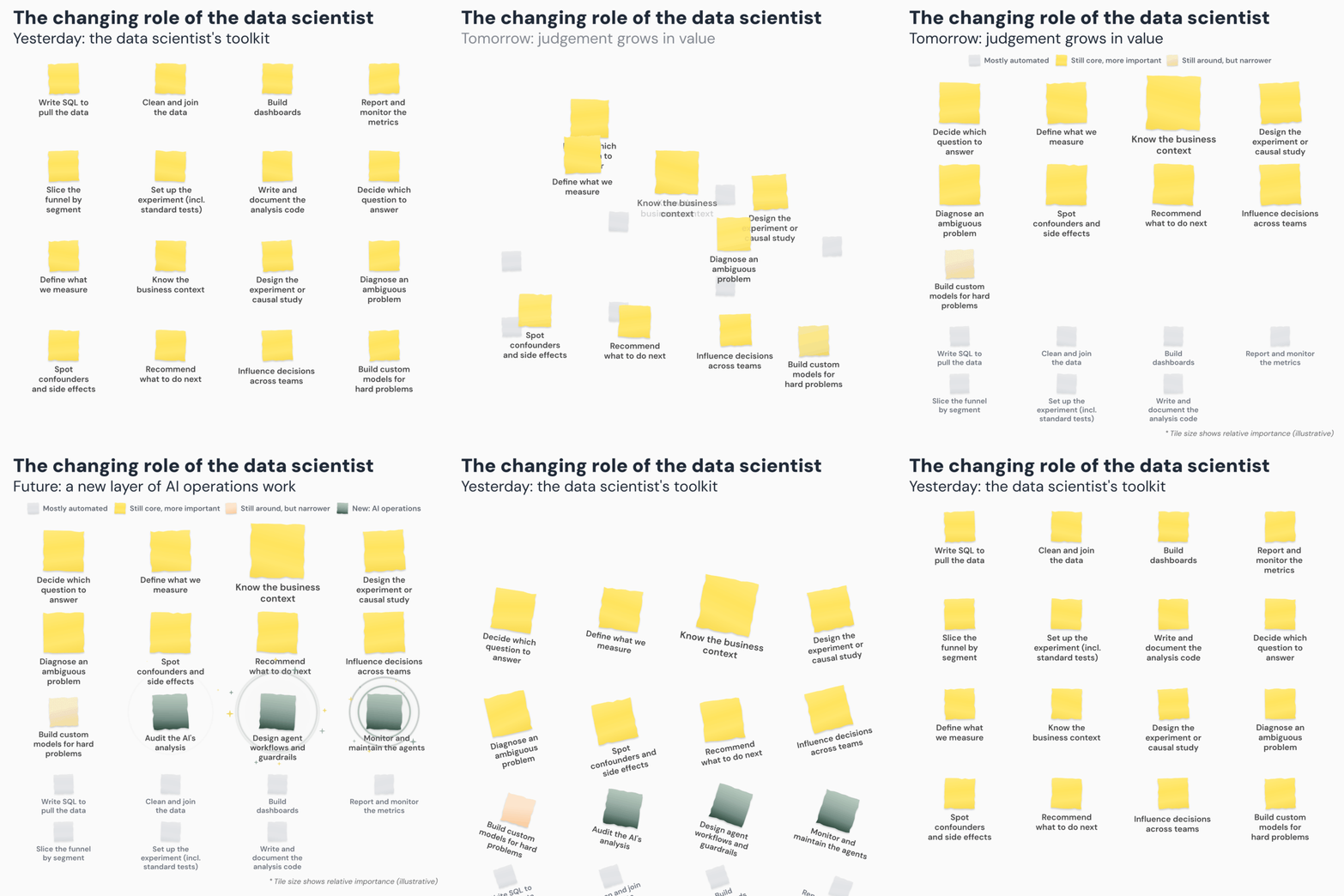
As data scientists and others lean on AI to accelerate their work, a new set of tasks is emerging: auditing the AI’s analysis, designing the workflows and guardrails that decide where an agent can run alone and where a person has to step in, and monitoring and maintaining the agents themselves. That never used to be anyone’s job. Increasingly, it’s going to be part of everyone’s.
The GIF below shows the evolution of data science tasks, from yesterday’s full task list to how the same tasks shift in importance as judgment becomes the scarce resource, and the new tasks that emerge around operating AI systems.
What are the viable data science roles in the future?
“Answering hard questions” is perhaps the task most susceptible to the Jevons paradox of all. Ramp found that when it got easier to ask questions, people asked 10-20x more of them.
So there is still going to be a lot of analytical work, and many viable paths for people in data roles today. However, because the function is changing so fast, doing the same kind of job that existed in the past is probably not one of those options.
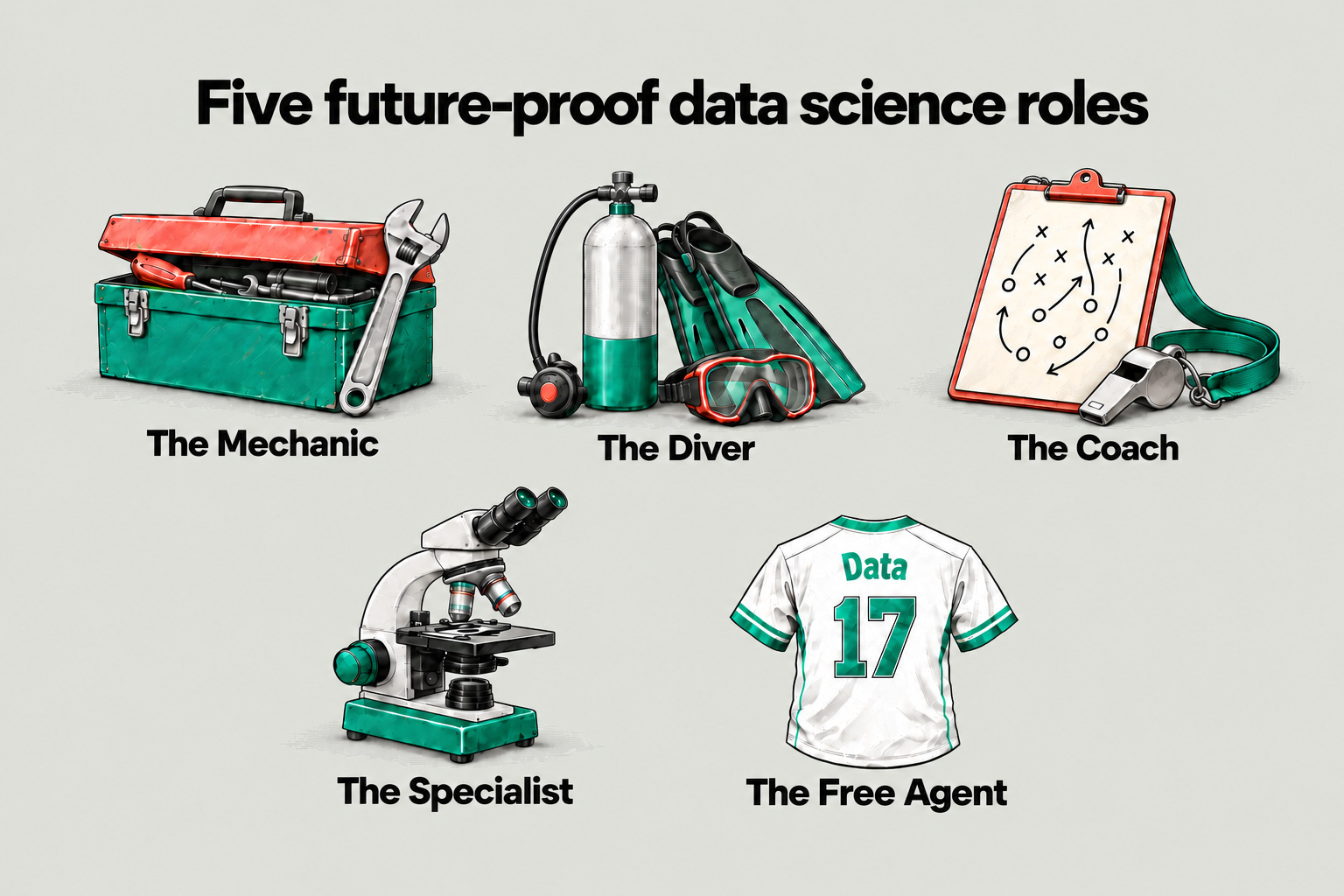
Below are five great roles we see for data scientists over the next 3-5 years. These are not mutually exclusive: we expect that many people will take on a mix of these roles as the function evolves.
The Mechanic
Analytical harnesses will let anyone self-serve on data, and automatically anticipate and answer routine questions. But they will also require significant effort to build and maintain.
The functionality and use cases of the harness will always expand, and someone needs to figure out where the line is between what is automatable and what is not. The context is constantly changing as the business expands, new products launch, and definitions change. The outputs will need error checking and fine-tuning. And most of all, people from around the org will have questions about how to interpret and what to do with what they’re seeing.
Talented people from the data org, who both understand the data and know how to translate this into what the rest of the org needs, are the best candidates for this work. Most data scientists will have some elements of this role in their jobs, maintaining context and use cases specific to their parts of the business. Others may shift to work on it exclusively from a more holistic perspective. In many orgs today, there is an opportunity to raise your hand and start helping to build the machine, which will put you at the very edge of how AI is applied to data science.
The Diver
There is a significant class of questions that analytical harnesses will still struggle to answer. These are one-off, deeper explorations that are often into new, low-context, or particularly complicated domains. Common topics are assessing a new opportunity, figuring out how an initiative is performing, or prioritizing what a team should work on next.
These problems typically require a lot of back-and-forth iteration, pressure testing with multiple people on the team, pulling in non-analytical signals like customer feedback, and strong business judgment to interpret and apply the findings. They’re also higher-stakes, and leadership is more likely to want to know that the work was done by someone they trust.
These tasks will become a larger part of the typical data scientist’s job, and some may shift to working on them almost exclusively. They will orchestrate teams of agents to cover more ground and answer many more of these questions than they could before.
The people who will thrive in these roles love answering hard questions, have particularly strong judgment, and ramp up quickly on new problems. Every data team already has some of them: they’re often the ones who switch teams the most or are tapped to jump in whenever there is a particularly gnarly new problem. That role will be formalized and expanded over time.
The Coach
More people from across the org are doing their own analysis than ever before, and this trend will only increase. Data scientists are best positioned to help them get the most out of this work.
This doesn’t mean acting as “homework graders”, constantly fielding one-off questions and checking accuracy. Analytical harnesses should do this job by helping fact-check and flagging areas where confidence is lower.
But there is an important role to play in helping other teams think like data scientists more broadly: understanding the data and what’s possible with it, knowing what questions to ask, choosing the right metrics and cuts, and turning the results into something the team can act on. This will become part of most data science jobs, and we expect that many companies will create entire roles whose mandate is to empower the rest of the org to do their own work with data.
The Specialist
As some of the more mechanical work is automated or moved to other teams, it will free up time to specialize in deeper areas that still need dedicated ownership.
These areas require expertise in specific analytical methods or tools and someone to own and maintain the agentic systems that support this work.
Some of the examples that we see include:
Experimentation: owns experimentation methodology and impact banking logic, advises on complicated experiment design and quasi-experimentation methods, helps automate test setup and decisioning.
Media mix modeling: partners deeply with marketplace and growth teams, owns marketing measurement and budget allocation, runs incrementality and geo testing, especially for hard-to-measure channels.
Decision systems: owns and maintains the automated systems that make high-volume, repeatable decisions across the business. One example is an ad auction: deciding which bidding mechanism to run, how ad slots get allocated across advertisers, and how advertiser budgets get paced throughout the day.
The Free Agent
Some data people won’t end up working on the “data science” or “analytics” teams at all.
In every company, roles are blending. As each function can now do more thanks to new tools, their scopes are overlapping. At the same time, many functions, especially product, engineering, and operations, require people who are naturally deeply analytical and understand the company’s data.
This is beginning to result in analysts transferring into new functions altogether, and that trend will accelerate. Sometimes when this happens, the analyst just takes an existing open role. But more often, they take on the new role’s scope while continuing to own their analytics scope.
Here’s an example of a dynamic that is increasingly common: the user acquisition pod needs a PM. The analyst on the pod starts playing the role of the PM while they’re hiring. But after two months, that PM role is not filled, and the team realizes the pod has actually been operating very effectively without it. The analyst officially takes over the “PM” role, but continues to own their analytical scope.
This will become increasingly viable as the analytical harness does more of the day-to-day analytical blocking and tackling, freeing up time for the former analysts’ new scope.
If you love data but are also interested in the work that another function is doing, now is an incredible time to start leaning into that new job. You might find a new role altogether.
What can data scientists do now to prepare?
No matter what path you want to take, there are several ways to invest in your career now.
Deeply learn the new tools
Embrace your curiosity and get to the edge of how AI tools are being applied inside your company. Most companies have a small number of people with very advanced knowledge and setups: your goal should be to get close to them, and ultimately become one.
This does not mean that you should try every hot new product or tool that comes out. In fact, that is often counterproductive, because most of these things don’t work, are too early, or won’t get adopted. Instead, start with the problem you’re trying to solve, and then go find the best tool.
Here are a few practical tips for how to get up to speed:
Shift to an “end-to-end” problem-solving mindset. AI is enabling data scientists to do more without being blocked by other teams. Do you really need engineering to fix logging, or can you do it? Do you need analytics engineering to build an ETL, or can you just build it yourself? Not only will this approach help you get more done, but it will force you to test the boundaries of what the new tools can do.
Pick a command-line tool such as Claude Code rather than a GUI. You will learn more about how it actually works, especially if you read about how it can be configured: context files, skills, hooks, sub-agents, connectors.
Start with feedback loops on problems you already know. Pick a question you answer regularly and can judge whether the outputs are accurate. Treat your agent setup for it as a product. Build v0.0, run it, see how good the answer is and where it fails, and improve it. This will teach you a lot about the strengths and limitations of the current tools and how to make them work better for your use cases.
Learn the meta-skill of agent orchestration. This includes figuring out how to chain agents together to run multi-step processes, where to insert yourself as a reviewer, and where AI agents are stronger and weaker at providing accurate results. In practice, this looks a lot like management: judging outputs, spotting the key pivot points, connecting the dots across steps, and turning a high-level problem into something an agent can actually execute. Treat your work with agents like you’d treat managing a team, and get real reps doing it.
Use agents to build custom visualizations. By using coding agents to generate HTML and Python, you can often get a great, bespoke visualization that can help others “get” your analysis more quickly.
Try enriching data in ways that were previously too time-intensive. LLMs are great at poring over individual records (e.g., transactions, fraud, reviews, etc.) and classifying or appending additional information to them, which can enable new kinds of analysis.
Test an opportunity sizing agent. Choose a top-level metric (like transactions) and set an agent up to “identify and impact size the biggest risks and opportunities”. This will often give you a great first pass at identifying and sizing potential initiatives.
Cultivate business judgment
“Learning better judgment” is easier said than done. It is one of the hardest things to develop. However, there are some practical things that you can do:
Never abdicate judgment to the LLM. Instead of just trusting outputs, use the Socratic method: ask it how it got to an answer and how it chose its methodology and approach.
Focus on understanding the business holistically. Intentionally learn about the business beyond what you need to know for your current role. Part of that is understanding the overarching business equation: how the company grows, how it makes money, and the key variables that determine whether it meets its goals.
Curate your information diet. A lot of good judgment comes through osmosis: exposure to the best businesses, ideas, and concepts gives you plenty of material to pattern-match. Identify the best writers, podcasts, and other sources, and seek them out. You can pair this with selective use of X (where a lot of the people at the frontier are posting their latest stuff) and presentations from the labs themselves.
Get in a good feedback loop. The unsatisfying answer to “how do I make good decisions” is mainly to just make a lot of decisions. And not just make them, but put yourself in a position where you can see if they worked or not. Early career, that often means being in a startup environment with a high pace and frequent at-bats, and having the humility to learn from your mistakes.
Surround yourself with high-judgment people. This could mean seeking out talent-dense companies, choosing a role based on who your manager will be, and intentionally finding mentors. For data scientists, it often also means figuring out how to work with great people in other functions, like PM and engineering.
Focus on relationship building and influence
As the data science role has evolved, data scientists spend more time working with people and less time working with data. The skill of influence is becoming more critical. That includes guiding the team to the right questions, shaping how they interpret the findings, and influencing their actions as a result.
How to build influence within your company:
Be intentional about relationship building. It is more important than ever to have close working relationships, certainly with your cross-functional partners, but ideally even more broadly.
Hone your presentation skills. Work on how you present and speak in meetings, especially those that are higher stakes or include leadership. Work on the art of communicating at the right altitude for your audience.
Get great at storytelling. It is increasingly easy to get lost in a sea of numbers. The most effective data scientists will figure out how to make people care: what is the problem we’re solving, why is it important, why is this solution compelling? It’s never been more important to get reps on storytelling, especially in your writing.
The job you actually wanted
Most people didn’t get into data science to write SQL or build dashboards. They got into it because they love figuring out which questions to ask and finding the right answers.
By eliminating the mechanical parts of the job, AI will give most data scientists much more of what they want.
That doesn’t mean the transition will be easy. The day-to-day work for most data scientists is going to change significantly. A lot of people are going to need to adjust the scope of their role.
But for those who approach the change proactively, it could be the most fun chapter of their career yet.
Credits
Thank you to Alexa, Anita, Ben, George, Jolie, and Matt for their thought partnership on this post.
For more from Jess, you can subscribe to her newsletter below. In my opinion, it is one of the very few places you can learn from a true expert about how to build data science and analytics teams and how they actually function inside top companies.