

Nine years ago, I watched two of Faire’s founders, Max and Daniele, sketch out their vision for a wholesale marketplace on a whiteboard. Faire was less than a year old with a team of under 10 people. Somehow, they had remarkable clarity about what they would accomplish.
Since then, the team has grown by >100x and revenue by >500x. Faire operates in 34 countries, connecting hundreds of thousands of local retailers with 20 million products from independent brands.
I’m fortunate to have played a part in that journey over those nine years, the first four as an advisor and the last five as our Chief Strategy Officer. I built the Strategy and Analytics (S&A) team, which encompasses what many companies call data science, product analytics, bizops, and corporate strategy.
After my longest stint anywhere, I left a few weeks ago and have been reflecting on what I learned. I want to share those lessons in case they are useful for anyone building a fast-growing company.
1. Speed wins
As we began to explore international expansion, one of Faire’s investors had a top 3 consulting firm on retainer and let us work with them to figure out the order in which to launch countries.
The consulting team did a bunch of research on each market, its composition, customer base, and local regulations. After about two months, they delivered their final report, which was by all measures very high quality, and probably correct.
The only problem was, by the time they delivered it, we had already launched most of the markets. It didn’t really matter whether their report was correct because we were already live, learning what worked and didn’t work.
I’m a “strategy” guy. I love breaking down problems, finding constraints, getting the right answer. But strategy is best practiced in a loop with execution, not as something that precedes it. You have to just start building, assess what you learned, adjust, and start again.
The company that turns that loop the fastest wins.

2. Apply constant force
In the early days at Faire, I often heard Max use a phrase from Michael Moritz about what separates the best companies from the rest: constant application of force.
Applying constant force requires being relentless. At Faire board meetings, the better our numbers, the harder they would push us to do more. We got a 30-second victory lap before the discussion would shift to what to do next. It’s a running joke among our management team that no matter how good the results are, Max will raise the goals by 10%.
It also requires focus. You can’t apply force everywhere, because startups are resource-constrained. The scarcest resource of all is great people who can own projects. One of my early failure modes was, once something was really working, taking the owner off of it to go work on something new. I ultimately learned to ask myself: “Is this new opportunity worth the risk of the original thing slowing down?” Often the answer is no; keep applying force.
And most importantly, it requires longevity. You must apply force for the life of a successful company, which is measured in decades. When I first met the Faire team, they were working 12 hours a day, 7 days a week. It’s probably what was needed in that moment, but it wasn’t going to work forever. When I decided to jump in full time, I had just had my first daughter. Most of the leadership team also had kids. The company needed a rhythm that we could sustain for years, and through trial and error, we found it.
Applying constant force means relentless effort, sustained for years, against the things that matter most.
3. Hard = defensible
From the beginning, Faire offered free returns and net 60 payment terms to retailers. That means they could try out a new product line for two months and send it back if it didn’t sell, all before paying us.
Retailers loved it, but it was very expensive. So expensive that it led to one of my biggest career mistakes: not joining Faire full-time right away. The main reason I didn’t join then was that we were losing money on every order.
But through many iterations of figuring out which products would sell well for which retailers and the size of credit limits we could offer, the team got those unit economics under control. Thanks to people like Jevin, they are now a small and predictable part of the cost structure.
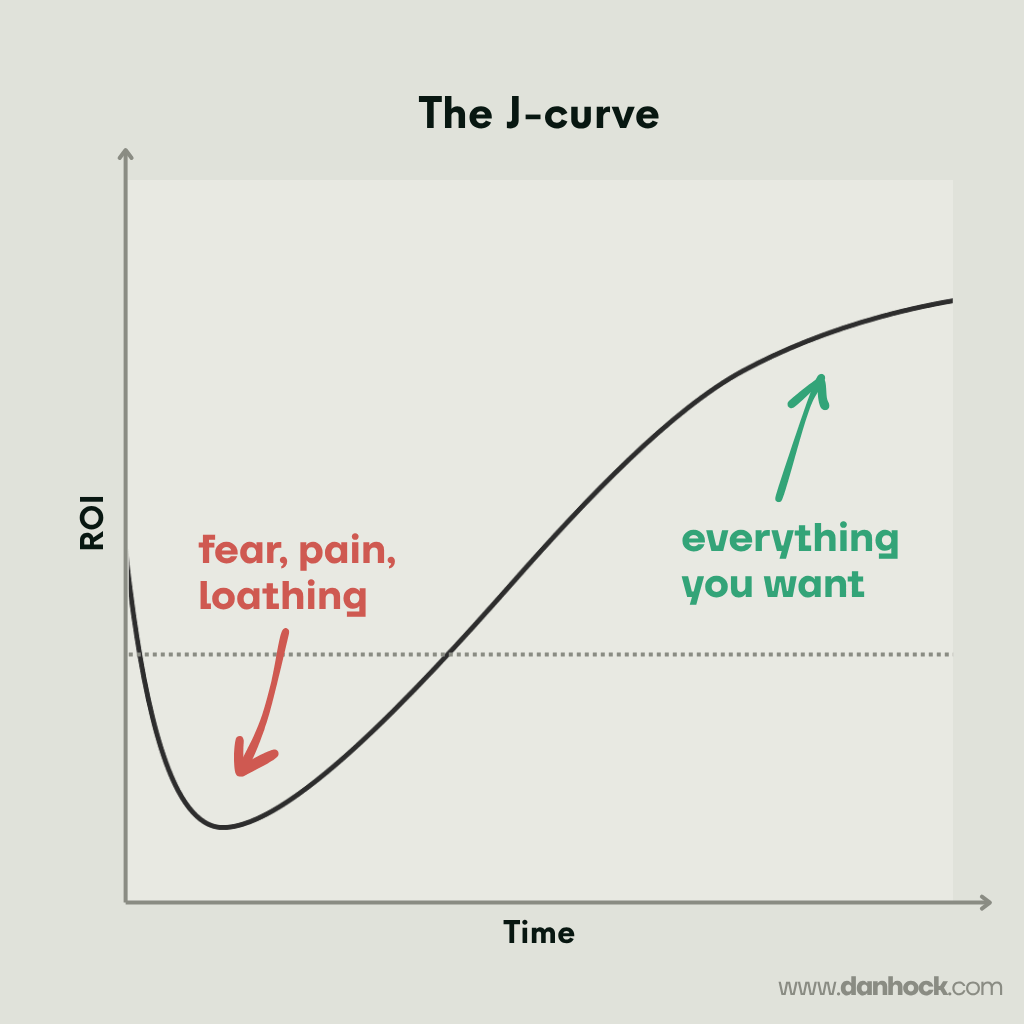
There have been at least 5 or 6 moments since then when the team was assessing a new opportunity, and it became clear that it would look like free returns: a complicated, risky, multi-year journey. International expansion, our free shipping program, launching a credit card all looked like this.
And in each of those moments, I remember Zach saying something to the effect of, “The fact that it is hard is part of what makes it worth doing.” His point was that once we figured it out, we would be able to offer something uniquely valuable to our customers, setting us apart from companies less willing to make the effort.
Figuring out hard things leads to defensibility. Every great business is on the other side of a series of J-curves:
4. Always be recruiting
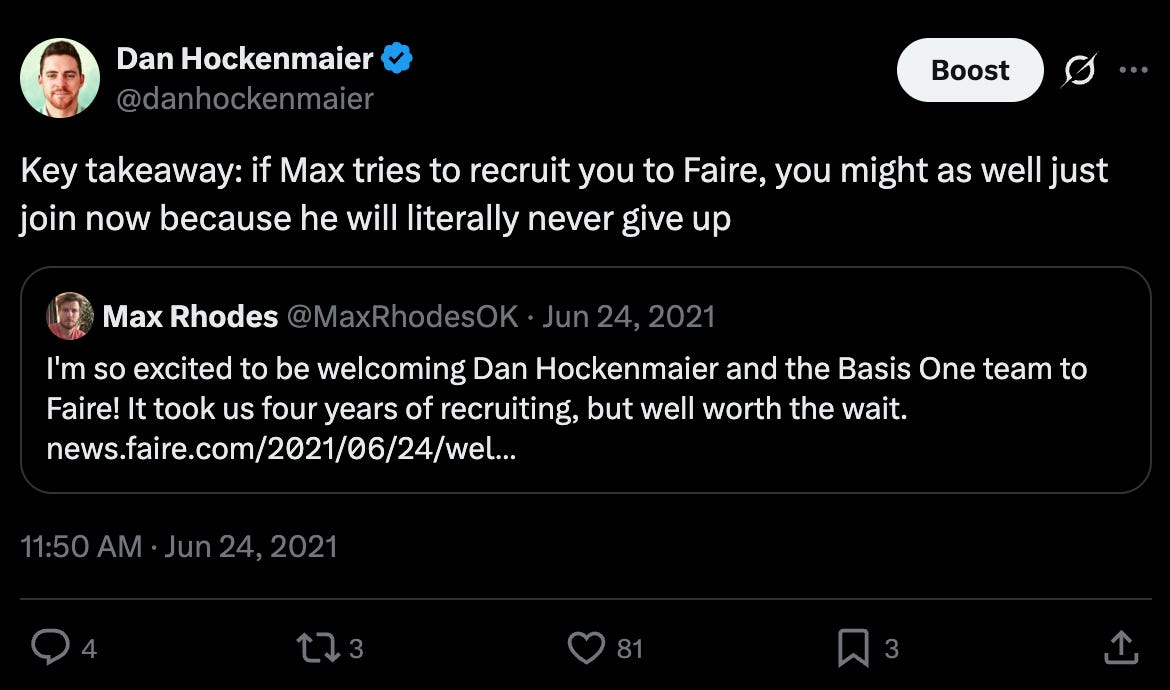
Our CEO Max is one of the best recruiters I’ve met. I know because it worked on me. I finally accepted his 5th or 6th offer:
When I did join, the S&A team was in a big hole - the company was growing fast, and our team was understaffed.
Jolie and I went heads down on recruiting as our top problem. After 9 months, we had made a bunch of great hires and finally saw some daylight. We started shifting effort to other things. But the company kept growing, and S&A developed a track record of converting people into other teams like PM. Within just a few months, we were in a hole again.
From then on, we vowed to never stop recruiting. At a fast-growing startup, no matter how good you are at retaining people, it’s always the #1 job. You should be thinking about it essentially all of the time. Constantly asking for referrals, constantly pitching smart people you know on joining.
And most importantly, you have to build the product of recruiting. It has acquisition channels, a conversion funnel, and a retention rate, just like any other product. And it should be managed in the same way. Build a team around it with clear DRIs. Define the most important metrics, track them, and constantly figure out how to improve them.
I hired more than 50 people during my tenure at Faire. The team is still hiring like crazy. It’s never done.
5. Betting on your team is a flywheel
We hired Sam onto the S&A team in 2022. It was actually our second try. She had turned us down six months before. But it worked the second time, and within maybe four hours on the job, it was clear it had been worth the wait.
No less than five times during her tenure, I called Sam to ask her to step up to a new opportunity. The first few times, it was to move to a different part of the business to take on a new, particularly hard problem. The last two times, it was to step into management roles: first leading a team of five, and then just a few months later leading a team of 12.
We did this over and over again with many people on the team. One of the things I’m proudest of is that for my entire last four years, we didn’t hire a single external leader onto the S&A team. Virtually the entire leadership team today — including Jolie, who now leads the whole thing — was hired as ICs and repeatedly promoted into more senior roles.
This approach tends to lead to more junior people in leadership roles than you’d otherwise have. They have fewer reps and need more time and space to make mistakes.
But in return, you get people with higher engagement, higher commitment, and a higher slope. They were recently doing the job of the people they’re managing at a high level of performance, which makes them better managers.
And most importantly, the more you bet on your people, the easier it gets to do it again. Over time, you get a deeper and deeper bench because you can credibly pitch new hires on their growth opportunities, and your existing team is more likely to stay because they know they have a path to growth.
6. Make your company a learning machine
Every company is flooded with information: data, customer feedback, missing goals, beating goals, experiments that worked and didn’t. The best companies build a machine that turns that flood into insight as quickly as possible.
Faire does this in two interconnected ways. The first is a deeply embedded writing culture. Before any major meeting, the team sends out a doc for leadership to read and comment on beforehand. At the meeting, it’s assumed that everyone has read the doc, and the only thing discussed is the responses to the comments. This lets us do two iterations on a problem at once, because each meeting captures a back-and-forth dialogue: the doc, the comments, the response.
The second is to hire people who will thrive in this environment. I’ve been asked hundreds of times about the top trait we hire for on S&A, and my answer is always the same: synthesis. This means the ability to parse noise and turn it into signal about what is actually happening and what we should do as a result. And it means the ability to communicate that efficiently, most importantly in writing.
This kind of culture is becoming increasingly important. If your company has every problem you’ve broken down and every decision you’ve made captured in docs, that is now all context for your agents. This means more people will be able to learn from the same insights, you’ll spend less time re-litigating old problems, and anyone can ramp up on new problems exceptionally quickly.
7. Everything breaks all the time
We hired a lot of people directly out of Bain, BCG, and McKinsey. They’re often very smart, and very motivated.
They’re also often unprepared for what it’s really like to work at a startup. After 3-6 months on the job, they would often ask me something like, “Is it normal for stuff to break this often?” It seemed to them that we were always shifting people around the org, changing their priorities, scrapping old processes and building new ones.
And the answer is yes, it’s normal. Maybe not at a big consulting firm working for big companies. But at a startup that is doubling or tripling every year, you just can’t predict what you’re going to need more than 9 or 12 months in advance. If things feel too stable, it probably means the company isn’t growing fast enough or is too slow to adapt to changing needs.
When hiring, you should explicitly assess for people who can handle this. They need to be resilient, adaptable, and not too precious about exactly what they get to work on or who might “step on their toes”.
Ironically, one of the best at this came directly from Bain. Tom leads our core strategy team, whose job is basically to work on whatever is on fire. Their scope often does a 180 in an afternoon when some big new question arises or a team needs help. He’s figured out how to make those pivots without any loss of energy.
This doesn’t mean you want people to be exposed to thrash. One of the most important roles of startup leaders is to insulate their team from it, minimizing the amount of time they’re in change management mode and maximizing the amount of time they’re in execution mode.
But thrash is an inevitability of startup life, and it’s best if the whole team embraces it.
8. Manage “org debt” like you manage tech debt
When I first joined, I got pretty annoyed with our People team.
I had previously been running a company where I could make unilateral decisions about hiring, comp, and staffing. I tried to replicate that at Faire and ran into “rules” that felt like they were slowing me down unnecessarily.
What I came to realize is that when it comes to your org, trying to go too fast in the short term can come back to bite you. This is what the People team was trying to combat.
You might relax your hiring standards to get a candidate across the line. You might promote someone before they’re ready. You might allow a meeting to get too big because it’s easier than explaining to someone why they’re no longer invited.
Over time, all of this adds up to “org debt.” It’s just like tech debt: it accumulates every time you take a shortcut instead of doing things the right way. And at some point, it will become too much. It will start to bog you down, decisions will seem arbitrary, your best people will get frustrated and leave.
The hard part, and one of the things that makes our CPO Neervi world-class, is figuring out how to combat org debt while still moving fast. It’s mostly about having clear principles around the few things that actually matter, and empowering leaders to do the rest. Striking the right balance enables the highest velocity in the long term.
9. Data is not enough
I love data. Faire loves data. Being data-driven is a superpower, especially for a business this complex.
But it’s not enough. You can see a dashboard go up and to the right. GMV can increase 2x, 10x, 100x. Your brain knows it’s impressive. But it doesn’t make you feel anything. It’s not going to give you the motivation to keep plowing energy into the business for many years.
For that, we need stories. Especially stories about how we’re improving the lives of our customers and the world around us. The best companies figure out how the whole team can get constant exposure to customers and their stories.
For the four years I was an advisor, I knew intellectually that Faire was a great business. It was growing fast, unit economics were improving every quarter, and it had the best customer retention numbers I’d ever seen in a marketplace.
But then I met the owner of a local retailer a few blocks from my house. She told me that her previous business was destroyed by the pandemic, and that it was only because of Faire that she had been able to open her new store.
It wasn’t until then that it really clicked. The street she chose is so much friendlier because her store is there. That is the kind of neighborhood I want my daughters to grow up in. I knew I needed to be part of making this happen all across the world, and it was one of the things that finally nudged me to take the leap to join full-time.
Fast forward to my last month at Faire, attending my very last leadership retreat. We always invite customers to speak, and one of them was the founder of Moss Amigos, a brand that sells moss ball “pets” that first got popular in Japan. I knew my girls would be obsessed with them, and ordered the “family” pack on my way home.
They arrived a week later, and within 20 minutes, my daughters had not only unpacked them but named them all after each member of our family. They still check on them every morning, and they still get a little smile every time they do.

I love numbers, especially when they go up. But if those numbers don’t represent something that you want to see more of in the world, what’s the point?
Great article @danhock, and thanks for sharing snippets from your experience. Found all 9 quite insignful, especially the 9th one - Stories are one of the greatest ways to align and keep up the motivation.
Great read Dan.
The point I would keep is this: growth is rarely a collection of tactics. It behaves more like an operating system. Cadence, clarity, talent density, decision quality and culture either reinforce each other, or they start working against each other.
The real test usually comes after the first wave of growth. At the beginning, companies can move fast thanks to individual effort, personal commitment and a few people carrying a lot of weight. That works, until it does not.
Sustainable growth needs something less heroic and more disciplined: repeatable mechanisms, explicit ownership, better decision hygiene, and the willingness to retire practices that helped in one phase but become friction in the next.
I also like the emphasis on meaning. High-growth companies can easily become execution machines. The stronger ones preserve speed without losing reflection. People need to know what they are building, but also why it is worth building.
Useful reminder: growth is not only a metric. It is an organizational capability.